

Case study 02 · Launch site
Ladeira
The problem
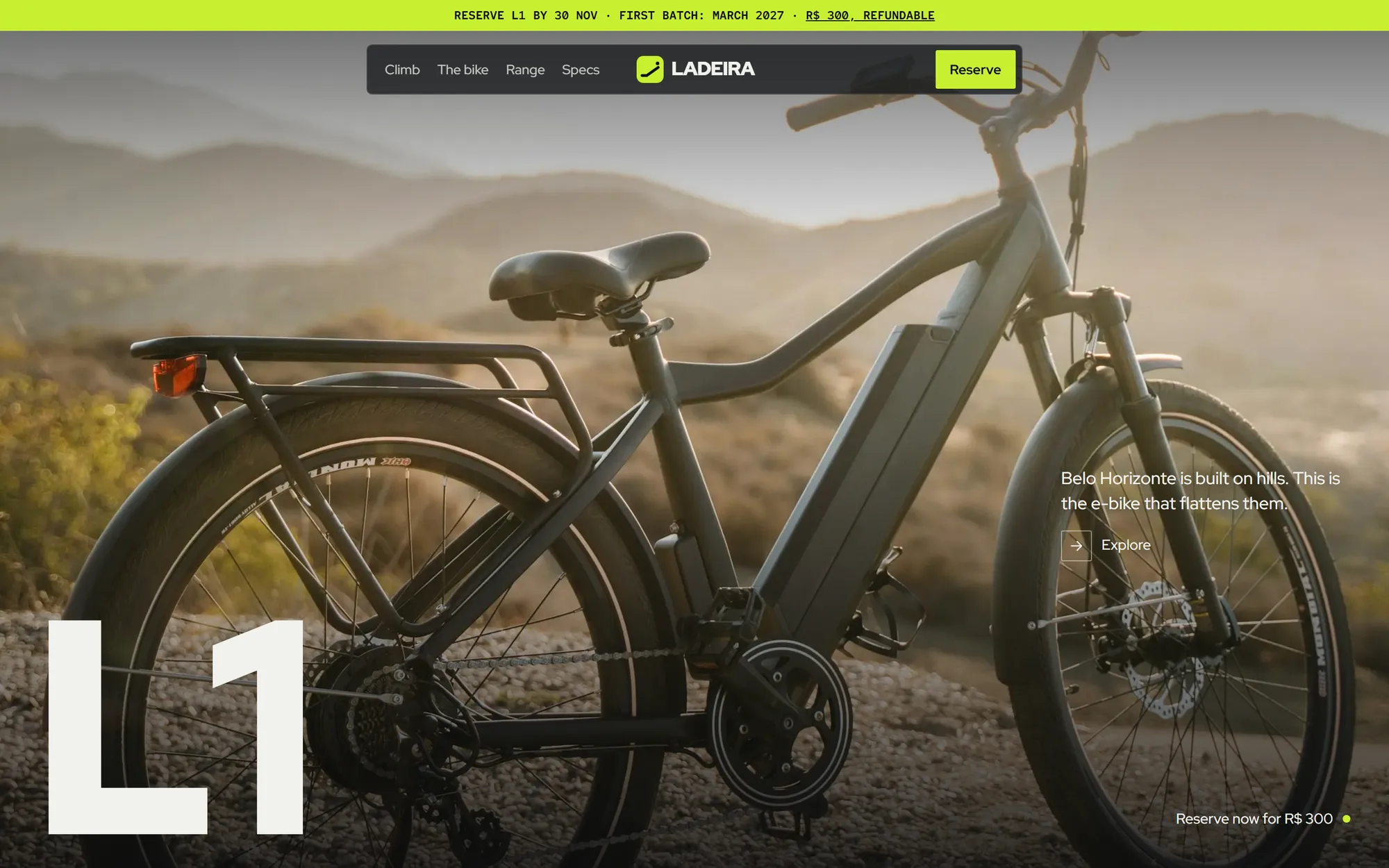
Belo Horizonte is built on hills, and a hill is the first reason people give for not cycling to work. Ladeira L1 is an e-bike sold on one promise: the hill stops mattering. Its launch page has to make that promise believable with numbers and then take a R$ 300 reservation on the same page.
It answers the postings that ask for a marketing site with motion built in code. The scroll animation here was specified and built by the same person, it works at 390 px, and the page reads the same with motion turned off.
See it work
Three things to try:
- 01
Scroll into the climb. The page holds still while you ride Rua do Morro Alto, 63 m up in 600 m, and the readout splits the work between your legs and the motor.
- 02
Set the range to Climb mode, a steep route and 120 kg, and watch the km and the commute days drop.
- 03
Reserve a bike. Then open the page with
?state=failedto see a payment fail with your choices kept.
How it was made
Spec
The product, its numbers, and a name checked free on the web and at its address.
Brand
Three directions side by side, one kept.
Prototype
Three layout rounds, ending with each section copying a competitor's composition with product photos.
Photos
A real brand's free product photos, with its logo retouched out of all 13.
Build
The production stack, with the climb, range and size models under unit tests.
Checks
Every state rendered at 1440 and 390 px with accessibility checks, reduced motion included.
Scale
16
sections on one page, plus a 404 page.
24
states checked at two widths, 48 renders.
3
brand directions and 3 layout rounds (vector drawings, background video, product photos), over 5 rounds of review.
13
photos retouched and built into 49 responsive WebP files.
26
icons drawn for the product.
2 h 24
from the decision to make it to the approved spec, then about 2 h for the build.
What went wrong and what I changed
The approved spec promised 110 km of range in Eco on the flat, and the range model in the same spec gave 83 km. The prototype never showed the gap, because the range tool only displayed its own result and nothing put that result next to the headline.
The first unit test I wrote for the model asserted the headline and failed. Two more claims disagreed with the model as well: 40 km in Climb on a hilly route, and the specs table's "40 to 110 km". I kept the claims and changed the model. Eco, Tour and Climb now use 4.9, 6.2 and 7.7 Wh/km, which give 110 km at one end and 40 km at the other, and a test ties each claim to the model.
Limits and next
- The reservation and the newsletter are mocked in the browser. Nothing is charged or sent, and there are no accounts.
- The photos show another brand's bike with its logo removed, so the configurator offers the two frames those photos show instead of paint colours.
- The page is in English only.